News Articles
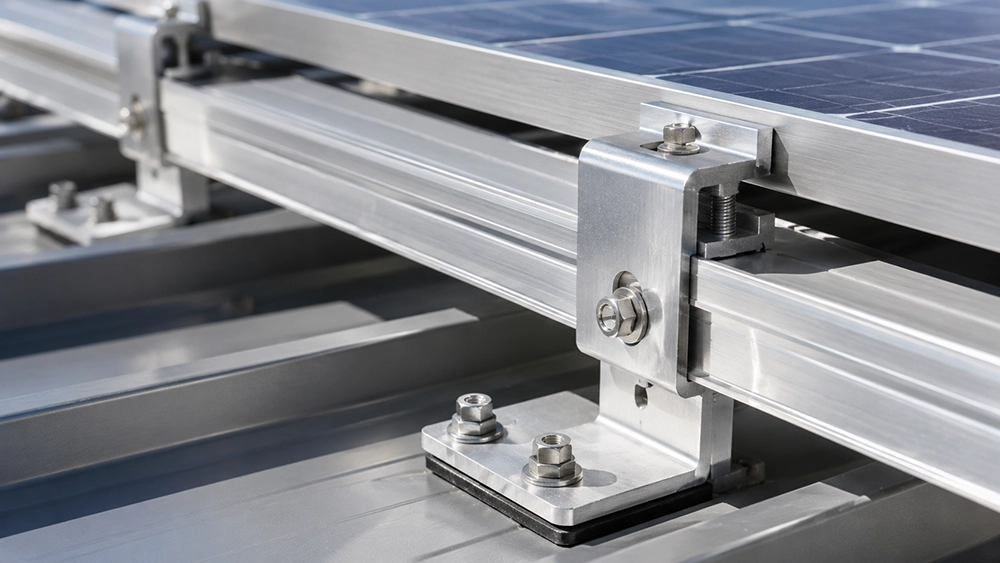
Metal sheet roofing is the number one choice for commercial buildings, industrial plants, warehouses, and modern residences due to its strength, durability, lightweight design, quick installation, and reasonable price. Because of these qualities, metal sheet roofing has become a primary choice for installing Solar Rooftop Systems, helping businesses save on electricity costs.
However, the biggest concern building owners often have when considering installing solar panels on metal sheet roofs is, "Will the roof leak?" or "Will the mounting brackets withstand strong winds?" This article will take you on a deep dive into the engineering techniques for selecting solar mounting clamps, the correct installation methods, and ways to permanently prevent water leaks 100%.
Types of metal sheet roofing and the selection of mounting equipment (Solar Mounting)
Modern metal roofing sheets come in a wide variety of types and profiles, each requiring completely different techniques and mounting equipment. These include:
1. Screw-type metal sheet roofing
This is the most common type of corrugated roof. Solar panels are installed on this type of roof using fasteners called L-Feet, which are attached directly to the roof ridge using high-quality self-drilling screws with built-in EPDM (Ethylene Propylene Diene Monomer) rubber seals to prevent water leakage at the drilled joints.
2. Clip-lock metal sheet roofing (Kliplok / Seamless Type)
This is a drill-free roofing system. Solar panel installation uses Kliplok Clamps, or steel ridge clips, to directly attach to the roof ridges without drilling a single hole in the roof panel. This is the safest method, preventing water leaks 100% and does not void the building's roof warranty.
3. Corrugated metal sheet roofing (Standing Seam Type)
Often used in commercial buildings or modern designs with shallow roof pitches. Installation involves using a Seam Clamp to securely clamp onto the roof panel's fold seam, without the need to drill holes in the roof panel like with the Kliplok system.
Comparison Table: Solar Panel Mounting Devices Categorized by Metal Sheet Roof Type
| Types of metal sheet roofing | Mounting devices | Installation characteristics | Level of risk of water leakage |
|---|---|---|---|
| Bolt-type fasteners | L-Feet + EPDM Rubber Washer | Drill and fasten to the ridge of the roof | Low (If using engineering-grade sealing materials) |
| Kliplok (clip-lock) | Kliplok Clamps | Clamp and secure to the roof ridge (No drilling required) | No risk (0%) |
| Folded wave, Standing seam | Standing Seam Clamps | Clamp and secure to the seam/fold (No drilling into the roof) | No risk (0%) |
Safe roof sealing and drilling techniques by our team of engineers.
For buildings using bolt-type metal sheet roofing, maintaining high workmanship standards is paramount. Professional engineers employ techniques to prevent water leakage according to international standards, as follows:
1. Drill and fasten only at the "ridges" of the corrugated roof.
Never drill or fasten screws into the "underside" of the roof ridges. The underside of the ridges is where rainwater flows; drilling there will allow water to easily seep through the screw holes. Drilling on the ridges will allow rainwater to flow to the sides and not accumulate in the drilled area.
2. Use industrial-grade EPDM nuts and seals.
Use special stainless steel nuts and washers (Stainless Steel with Neoprene/EPDM Washer) that are highly resistant to UV radiation and high temperatures. They will not become brittle or deteriorate over time, ensuring a leak-proof seal for 20-25 years of use.
3. Reinforce with a PU Sealant (Polyurethane) waterproofing chemical.
At every drilling point, high-quality polyurethane (PU) sealant is injected into the hole and then applied over the bolt heads. The PU sealant is highly flexible and perfectly resistant to the expansion and contraction of the metal sheet due to daytime heat and nighttime cold.
Wind load testing and structural integrity testing of steel roofs.
Besides water leakage issues, a crucial structural engineering factor is wind load analysis. Solar panels installed on metal sheet roofs act like "wind vanes" during summer storms or strong winds.
The engineering team will use wind load simulation software according to the Thai Public Works and Town Planning Department's standards to determine the appropriate spacing of the aluminum rails and the number of clamps. This ensures that the solar cell system will not detach, warp, or cause long-term damage to the building's roof purlins.
In summary: Enjoy peace of mind and worry-free roof leak prevention when you choose Energy X for your roof installation.
Installing solar panels on a metal sheet roof isn't daunting if it's designed and executed by a team of expert engineers who understand roof structures and use the correct, specialized, engineering-grade fasteners.
Energy X prioritizes the safety of our clients' buildings and assets. We have a team of civil engineers who inspect roof structures, calculate load capacities, select internationally standardized mounting equipment, and guarantee meticulous waterproofing installations. This ensures your business can save on electricity costs without worry for 25 years.
Want to install solar panels on your metal sheet roof but worried about roof leaks? Consult the structural engineering team from Energy X for a free site assessment and calculation!